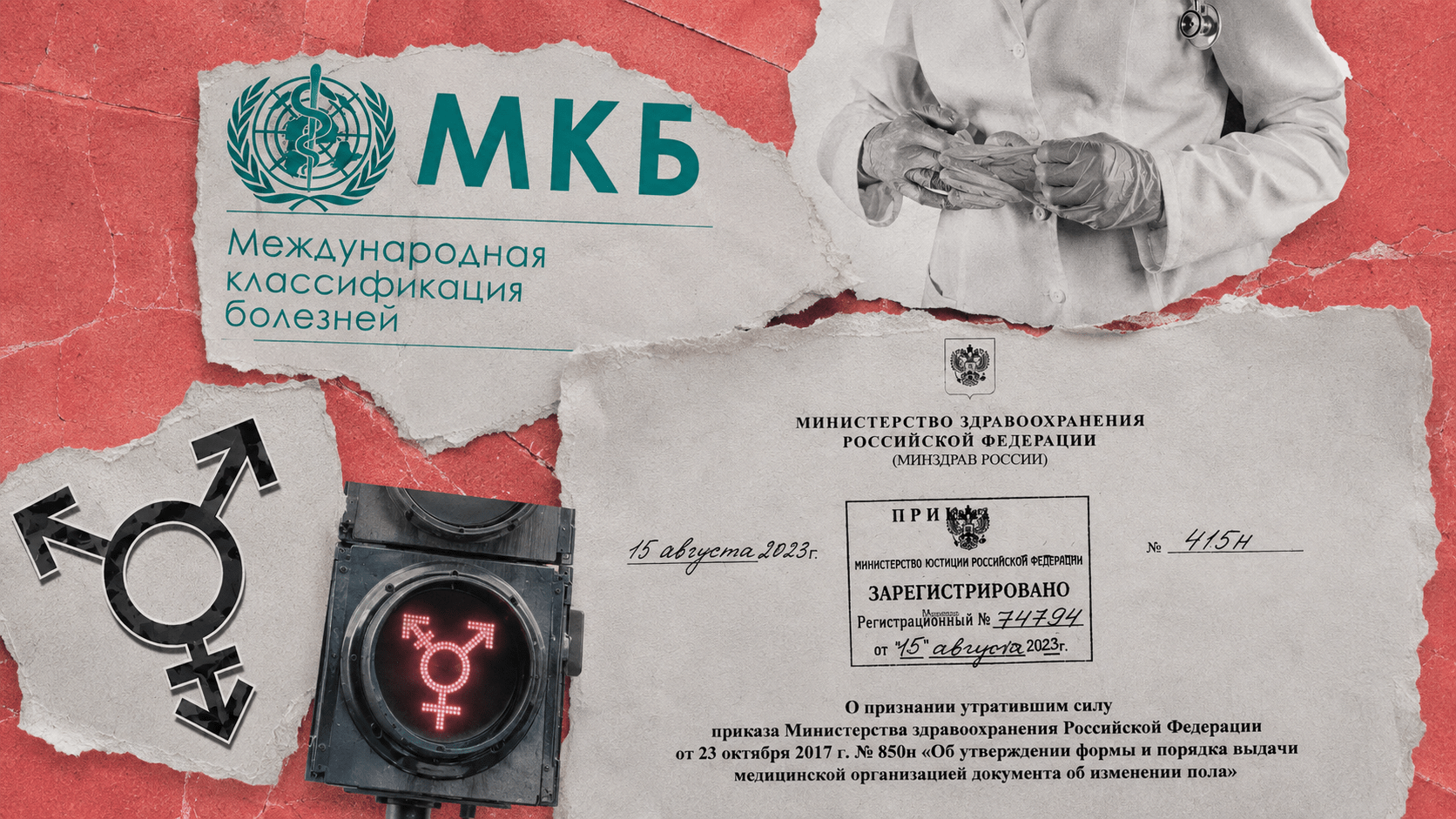
Olga Bukhanovskaya, chief medical officer at the “Phoenix” Medical and Rehabilitation Research Centre, spoke of a ‘transgender epidemic’ at the 18th Congress of Russian Psychiatrists. Bukhanovskaya claims that in Russia there is a ‘fifth column within the medical profession’ engaged in “propagating transgenderism”, comprising “trans-LGBT-friendly doctors”.
A psychiatrist proposes distinguishing between ‘transsexualism’ from “transgender spectrum disorders”, which allegedly comprise “five conditions”, including homosexuality, “fetishistic transvestism” and “sluggish schizophrenia” — a term used in the USSR to pathologise any socially non-conforming behaviour.
The speaker advocates a return to pathologising terminology and opposes “the promotion of gender theory and the ICD-11 within the professional community, society and patients’ minds” (which has never actually been adopted in Russia).
However, Bukhanovskaya’s speech raises a host of questions even within the framework of a conservative trans-medicalist approach, which is criticised by the majority of the trans community and activists, and from which the ICD-11 is partly moving away. Furthermore, the trans-medicalist approach still implies the provision of support in the form of gender transition. This is prohibited in Russia — a fact the speaker seems to have overlooked.
Sasha Starost, coordinator of the psychological division at FAR, explains exactly how Bukhanovskaya’s ideological framework leads to the normalisation of conversion therapy.
Transsexuality vs transgender identity
Transsexuality and transgender identity are not two different things. It is quite interesting to see how Olga Bukhanovskaya contrasts them, because they describe the same condition. ‘Transsexuality’ is simply an outdated term that does not quite accurately (including biologically and medically) describe what is happening. “Transgender” is a more modern and accurate term, because biological sex cannot be directly changed. That is why we talk about a change of gender and about socialisation in the opposite gender.
Is a differential diagnosis of transgender identity necessary?
Bukhanovskaya contrasts her supposedly scientific psychiatric approach with the “propaganda of gender theory”. Her ideas can be compared with the actual transmedicalist approach that has emerged in psychiatry, which involves the diagnosis of so-called “true transgenderness”.
Russia still uses the ICD-10 — this classification included the term “transsexualism”, and diagnosis was largely based on the presence of severe inner distress, anxiety or depressive symptoms (dysphoria) caused by one’s body.
In the ICD-11, the concept of “transsexualism” has been removed from the class “Mental and behavioural disorders” and replaced with the neutral term “gender incongruence” in the class “Conditions related to sexual health”. To make this diagnosis, the only requirement is a “marked and persistent incongruence between the person’s experienced gender and the sex assigned at birth”. Nevertheless, even the ICD-11 specifies a differential diagnosis from schizophrenia-spectrum disorders and body dysmorphic disorder.
In this way, doctors protect the patient and ensure that they are making an informed decision about transitioning, rather than acting under the influence of a mental disturbance. Body dysmorphic disorder — a rejection of one’s own body, a severe fixation on specific features, which can reach psychotic levels. Psychotic and delusional disorders may, amongst other things, include delusions regarding transgender identity — simply because delusions can encompass absolutely anything that interests the patient, forms part of their inner world, and is accessible to them in the outside world.
If one were to follow this logic, such a diagnosis would be just as necessary in, for example, plastic surgery.
Consequently, a person cannot simply gain access to state healthcare services on the basis of a mere desire to transition, and in this context, they cannot be the sole person to determine their own transgender identity. This approach has been criticised by contemporary trans activists.
However, Bukhanovskaya’s statements do not fit into any framework, even within the confines of this rather conservative viewpoint.
Is there such a thing as ‘social contagion’ when it comes to transgender identity?
Of course not. There can be no such thing as a ‘transgender epidemic’ allegedly induced by LGBT-friendly doctors and the ‘fifth column’. But let’s suppose that we can call a situation where a group of teenagers all start identifying as non-binary at the same time a form of ‘social contagion’.
In any case, this is part of perfectly normal teenage practices involving the exploration of one’s gender and sexuality. It’s just that in the past there wasn’t a name for it, but experimentation with gender and sexuality has always taken place.
Just look at role-playing or goth communities, at how they dealt with non-binary identity, transgender identity and homosexuality back then — simply by calling them by different names — and how people expressed these identities at a time when there was no vocabulary for them. Even the transmed approach considers this process of self-discovery to be normal for teenagers: some will cease to identify in this way; others will come to see themselves as homosexual or transgender people. There can be no question of any sort of ‘contagion’ that turns non-transgender people into transgender people forever.
‘Transgender spectrum disorders’
Bukhanovskaya lists the ‘disorders’ that are supposedly ‘under the umbrella’ of transgenderism. Let us set aside the fact that she refers to homosexuality as a disorder.
Among other things, she lists schizophrenia, schizotypal disorder and any personality disorders. By saying that these disorders fall ‘under the umbrella’ of transgenderism, she is effectively claiming that they are all, as it were, offshoots or forms of transgenderism. This implies that all patients with schizophrenia, personality disorders or schizotypal disorder are transgender, which is, of course, utter nonsense.
Schizophrenia, as has been said
It is worth noting that Bukhanovskaya, amongst other incorrect terms, uses the term ‘sluggish-progressing schizophrenia’. There is no such thing as sluggish-progressing schizophrenia. It is an artificially created diagnosis that was devised to facilitate the practices of coercive psychiatry. The problem with ‘slow-progressing schizophrenia’ is precisely that it is impossible to diagnose.
When Professor Snezhnevsky coined this term in 1969, it came to be used as a pretext for committing various dissidents and those opposed to the authorities to psychiatric hospitals. The clinical picture of ‘sluggish-progressing schizophrenia’ is such that schizophrenia is, as it were, present, yet at the same time it is, as it were, absent.
For example, manifestations which, in genuine schizophrenia, would be very pronounced — such as ‘schizophrenic eccentricity’ (imagine a person who always walks around at home and out on the street to the shop wearing a knight’s armour) — are interpreted very broadly here. Even strange make-up might be labelled ‘schizophrenic eccentricity’. In other words, it is very easy to pathologise any completely natural, normal human behaviour and label it as ‘subclinical schizophrenia’.
It is important to bear in mind that there is no such diagnosis; it does not appear in any ICD, and for a long time now nobody, including Russian doctors, has been diagnosing ‘sluggish schizophrenia’. There are schizotypal disorders which are not schizophrenia as such (schizoaffective disorder, schizotypal disorder), but none of them have anything to do with ‘sluggish’ schizophrenia.
They simply exhibit traits characteristic of the schizotypal spectrum, without reaching the level of full-blown schizophrenia. So, since we cannot differentiate between subclinical schizophrenia and transgender identity, we cannot distinguish between the two. After all, we can always label the desire to transition to another gender and to socialise as such as a manifestation of some form of schizophrenic eccentricity or delusional idea.
There is a concept known as ‘blurred’ symptoms—that is, symptoms that have not fully manifested—in the context of subclinical schizophrenia. This is similar to how infantile psychosis was once viewed—the very condition that led to almost all autistic children being diagnosed with schizophrenia at around one year of age. This was based on the idea that, unlike an adult’s brain, a child’s brain cannot produce symptoms to their full extent because it is not yet fully developed, and therefore the symptoms will be ‘blurred’.
It’s the same here. Appearance and self-expression, speech, hobbies, interests, personality — absolutely anything can be subsumed under the concept of ‘blurred symptoms’. With this diagnosis, it is possible to pathologise virtually any human behaviour. In fact, this is both the problem with this diagnosis and its benefit to the state.
There is no help anyway
The only form of medical care currently available to trans people is gender transition (that is, hormone therapy, surgery, and so on). And we refer to a ‘transmed’ approach when a doctor determines that they are dealing with a ‘truly transgender person’ or a person with ‘gender incongruence’, and prescribes treatment on that basis.
Why make such a distinction in a country where gender transition is prohibited? How will treatment be provided to these people if, for example, we were to determine that this is, as the woman in the video says, ‘transsexuality’?
Why are we identifying this in the first place? What do we do with the diagnosis next? Are we trying to ‘un-diagnose’ the person? In that case, it turns out we have identified genuine trans people, distinguishing them from those with psychosis, from those with body dysmorphic disorder, or even, within Bukhanovskaya’s paradigm, from these so-called ‘transgender spectrum disorders’, — and then, instead of providing them with the only help currently available, what do we do?
Do we carry out conversion therapy?
This is precisely the conclusion that springs to mind, particularly given the reputation of the ‘Phoenix’ clinic, which is run by Olga Bukhanovskaya. And this trend is not encouraging.
To continue our work, we need your support!
In 2024, the Russian authorities declared us an “undesirable organization.” This means that people in Russia are now prohibited from sharing our materials and donating to us. If what we do matters to you and you want to support us, you can subscribe to our Patreon.
Related posts:
 “The Best Part about Manipulating People”: The Russian Foundation Pushing Abortion Bans
 Protest Against the Invitation of the Russian Delegation to the Sixth World Conference of Speakers of Parliament and The Summit of Women Speakers of Parliament
 “For all these 30 years, my country has either been shooting or preparing to shoot”